Diplomacy Sucks: A Manifesto
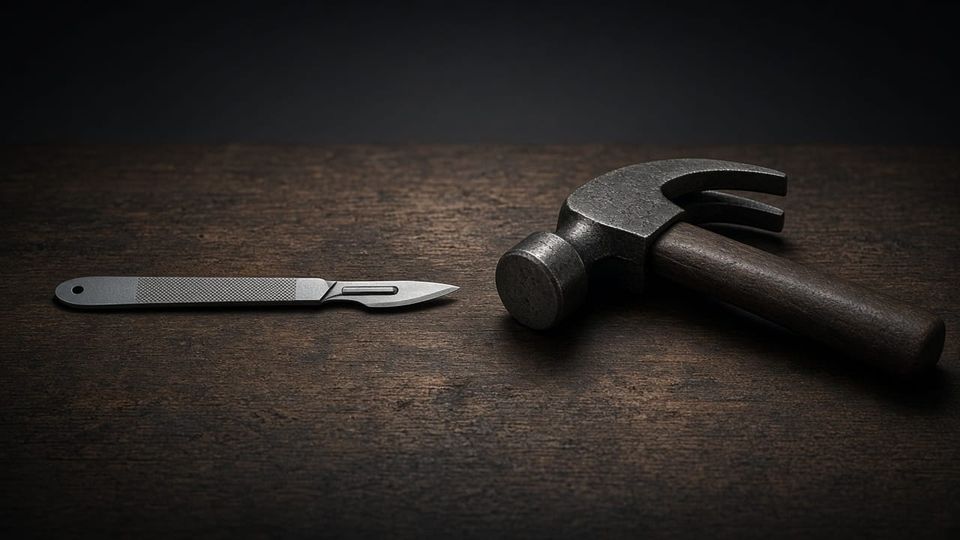
A Double-Tap from Diplomacy Sucks
Part One: The Scalpel
by Axel Calloway
The Three Failure Modes of Diplomacy
The instinct to defend diplomacy is understandable. In theory, it’s the mechanism by which disagreement doesn’t turn into destruction. That’s a real function, and a valuable one. To be fair, most people invoking “let’s be diplomatic” aren’t acting maliciously — they’re operating on a hope that patience will produce better outcomes than confrontation.
That may be sincere. It is not sufficient.
The problem with diplomacy as it’s practiced in most local and institutional settings isn’t the concept — it’s the assumption underneath it. Diplomacy assumes everyone at the table is negotiating in good faith, toward a shared goal, on a comparable timeline. In practice, that assumption fails in three distinct and identifiable ways.
Failure Mode One: Strategic Obtuseness
This is confusion as a tactic, not a condition. The actor understands the issue perfectly well; feigned confusion simply costs them nothing and costs the other side time. Diplomatic norms have no mechanism for naming this without sounding accusatory — and so the norm itself becomes the shield. If you call it out, you’re the one who broke decorum. The stall wins by default, because diplomacy has no penalty for wasting time, only for naming the waste.
Failure Mode Two: Bandwidth Failure
Not everyone who seems disengaged from a “nuanced conversation” is ignorant. Many are simply out of bandwidth. The diplomatic process assumes a reserve of patience, time, and emotional labor that a person working two jobs and raising three kids does not have lying around. What looks like apathy is frequently exhaustion. The tradeoff is this: diplomacy, as currently structured, is a luxury good marketed as a civic virtue — available in full to whoever has the least at stake.
Failure Mode Three: Genuine Bad Faith
Some actors are not confused, and they are not exhausted. They know precisely what outcome they want, and they know that diplomatic norms exist to protect good-faith disagreement. They use that protection anyway. This is the most consequential failure, because it’s the one diplomacy is least equipped to detect — its own rules of engagement were written to assume it doesn’t exist.
What follows from this
None of these three failure modes are solved by more patience. Patience is the fuel that lets all three run longer. What each of them requires instead is the same thing: a named cost, attached to a deadline, stated plainly enough that it can’t be quietly absorbed into “further discussion.”
That is not a rejection of diplomacy’s stated goal — reaching workable outcomes without destruction. It is a rejection of diplomacy’s current default setting, which too often protects the delay instead of the outcome. If we’re serious about outcomes, we need deadlines and receipts — not moods.
That’s the case for this column. Not noise for its own sake. A correction to a system that mistook slowness for wisdom.
Part Two: The Hammer
by T.C. Andrews
Diplomacy Sucks. Here’s Why We’re Not Sorry About the Name.
Let’s stop pretending diplomacy is some noble default we’re all rudely departing from. Diplomacy isn’t neutral. It never was. It’s a system, and like every system, it was built to work great for somebody — and that somebody usually isn’t you.
Here’s the part nobody wants to say out loud: diplomacy runs on patience, and patience is the one thing broke, tired, overworked people don’t have. You know who has patience? People who aren’t the ones waiting. The landlord isn’t in a hurry to fix the heat. The school board isn’t in a hurry to explain the budget. The department isn’t in a hurry to explain why the dog’s dead. They can afford a “productive dialogue.” You can’t afford another month.
So when we say diplomacy sucks, we’re not talking about manners. We’re not out here rooting for chaos because it’s fun to watch things burn. We’re saying something a lot simpler and a lot uglier: diplomacy has a price, and somebody’s always paying it — and it’s never the guy running the meeting.
There’s a version of “diplomatic” that just means “slow enough that nobody has to be accountable today.” Ask a hard question at a board or council meeting and watch how fast “let’s take this offline” or "let's table this until the next meeting" becomes the answer. That’s not diplomacy. That’s a stall wearing a nice suit.
And here’s the kicker — the stall works precisely because it looks polite. You push back on the stall, you’re the rude one. You’re “not being constructive.” Congratulations, you’ve just been diplomacy’d. The process protected the delay, not the truth.
We’re not interested in protecting delay. We’re interested in protecting the kid still waiting on a real education, the family still getting nickel-and-dimed by a tax stack nobody explained, the pet owner whose pet was needlessly shot by the cops, still waiting on an answer or justice that isn’t coming. Those people don’t need us to be polite. They need us to be right, and loud enough that it can’t be scheduled for next quarter.
So yeah. Diplomacy sucks. Sit with that.
© 2026 T.C. Andrews. All rights reserved. Reprint with permission.